Showing posts with label POST-pro paper. Show all posts

April 18, 2007

::Mobile Game-Based Science Learning::


Sánchez, J., Salinas, A., & Sáenz, M. (2006). Mobile game-based science learning. Retrieved March, 27, 2007, from http://apru2006.dir.u-tokyo.ac.jp/pdf/1a-4.pdf

[ABSTRACT]

This study describes and analyzes the design, development, application and evaluation of a new pedagogical methodology based on interactive games for mobile devices (PDAs). The methodology is oriented to developing problem-solving skills in science classes for 8th graders, by including pre-classroom activities with the teacher, classroom activities, and a central activity using an interactive game for a mobile device. The core problem they had to solve through the game consisted in preserving and evolving different biological species from the animal kingdom, in an unknown ad varying environment, by modifying some key factors for evolution of the species. The study was implemented in two main stages: a guided visit to a zoo observing animals directly, and a simulation game that takes place in the school during four weeks. Results show highly motivated learners with a fast adoption of mobile devices, fully engaged in a learning task without eternal control.

這個研究描述和分析新的教育方法:討論互動式行動遊戲的設計、發展、應用和評估。教學方式是發展8(國二)年級學生在自然科上問題解決的能力,包括課前和教師的活動,課堂活動和使用行動遊戲的中心活動。他們要透過遊戲中受保護和逐漸進化的生物種類,在一個未知和變化的環境裡,為生物的演化修改一些主要因素。研究執行有兩個階段:1.直接到動物園觀察動物;2.為期四週在學校的摸擬活動。結果顯示快速適應行動裝置的高動機學習者,在沒外在的控制下,完全專注於學習任務中。

[
Usability Testing]

這篇paper是著重在可用性評估方面和系統的介紹。研究中用了兩種評估方法:

  • Heuristic evaluation
此方法是由評估者個別檢視受評估人的人機介面,評估者依據12個主要原則(Jacob Nielsen)檢視介面中是否有違背這些原則之處,藉由此方法來找出介面中的問題。這個方法的優點是可以發現整體的問題,但深度比較不夠。
  • Cognitive walkthrough
它源自於認知模型,把認知模型轉換成數個簡單的問題,來作為評估者進行評估時的依據。評估前,介面設計者先定義受測系統的使用者、使用環境、主要的工作情節、以及各工作情節動作步驟等。評估者依據使者特性以及使用者環境來就每個工作情節的步驟詢問那些由模型轉換成的問題,來找出目前系統設計的可用性問題。這方法是以工作(Task)為中心,對工作做較深入的分析和評估,因此缺乏廣度的分析。
[Reference]

許銀雄,詹榮昌,(2006)。Heuristic Walkthrough 在網站人機界面可用性評估之應用。銘傳大學資訊管理研究所。

January 08, 2007

::Supporting Mobile Language Learning outside Classrooms::


Ogata, H., Yin, C., Paredes, R. G., Oishi, Y., & Ueda, T. (July, 2006). Supporting mobile language learning outside classrooms. Proceedings of the Sixth International Conference on Advanced Leaning Technologies (ICALT’06)(pp. 928 - 932).

Abstract

The continuous development of wireless and mobile technologies has allowed the creation of an additional platform for supporting learning, one that can be embedded in the same physical space in which the learning is taking place. This paper describes a computer supported ubiquitous learning environment for language learning, called LOCH (Language learning Outside the Classroom with Handhelds). In the environment, the teacher assigns field activities to the students, who go around the town to fulfill them and share their individual experiences. The main aim of this project, called One Day Trip with PDA, was to integrate the knowledge acquired in the classroom and the real needs of the students in their daily life.

這篇主要是利用手持裝置(PDA)、GPS和PHS來幫助在日本的國外學生學習日語。教師會給予學生任務,學生則利用行動裝置在城市中到處收集資料以完成任務。這計畫的目的是要結合教室中習得的知識到日常生活中。


電腦輔助行動學習(CSML)提倡不同的學習理論,如,Hands-on or minds-on learning;situated and authentic learning,強調親身經驗的重要性。相關學者也指出當語言情境化時,會結合知識背景,理解語言思考模式,然後開口說。

December 05, 2006

::The Literacy Fieldtrip::

The Literacy Fieldtrip: Using ubicomp to support children’s creative writing

Halloran, J., Hornecker, E., Fitzpatrick, G., Weal, M., Millard, D., Michaelides, D., Cruickshank, D., & Roure, D. D. (2006). The Literacy Fieldtrip: Using ubicomp to support children’s creative writing. Proceeding of the 2006 conference on Interaction design and children IDC '06, (ACM Press) (pp.17-24), Tampere, Finland.

ABSTRACT

Recently, ubiquitous computing (UbiComp) has been used to enhance fieldtrips in theseeducational areas by augmenting environments with a rangeof instruments, devices and sensors. However, the sorts ofinteraction design that UbiComp makes possible have thepotential not just to enhance the value of educationaltechniques in known application areas, but also to expandthe application of those techniques into new areas ofcurriculum. This paper report on a UbiComp-supported fieldtrip tosupport creative writing, associated with the learning ofliteracy skills. It discusses how the fieldtrip, designed andrun in the grounds of a historic English country house , engendered interactions whichchanged both the processes and products of creativewriting, with benefits for both teachers and children.


People: Year 5 UK schoolchildren at Whiteley School, Hampshire, UK. ; staff fromChawton House; and two senior teachers from Whiteley Primary School: the head teacher, Pam, and the deputyhead, Leila.

Place: Chawton House, also in Hampshire, owned by the Knight family from the 16th Century, is associated with the well-known English writer JaneAusten.

  這篇是報告在無線運算的戶外教學環境中,來幫助寫作和相關的素養技能(literacy skills)。討論如何在一個有歷史背景的環境中設計教學活動,來產生出互動以及創造寫作。
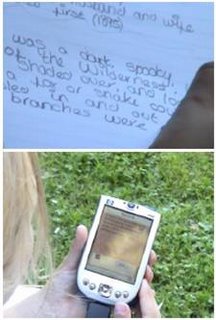
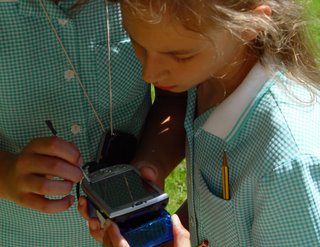
  學生發現目前的行動學習已朝向戶外發展的趨勢,較早所讀的paper中,大多都是探討在教室內如何將學習軟體與行動載具結合,應用在自然科學教學和學習方面。當然,行動載具的行動性是非常適合用來與環境和情境的互動,本來就該探討戶外的活動。這篇報告的所使用的教學理論基礎為素養技能,學習者不但能夠在環境中進行探索,最後利用探索的記錄寫成故事。研究中所使用的是混合工具:數位(PDA)和類比(筆記本和筆)工具,在寫作時,學習者意識到筆記本比PDA來的實用多了。的確,我們期待科技工具帶來的是輔助效果,而不是取代傳統教學。


December 01, 2006

::for Spatial Media::

A case study of Tangible Flags: A collaborative technology to enhance field trips

Chipman, G., Druin, A., Beer, D., Fails, J. A., Guha, M. L., & Simms, S. (2006). A case study of Tangible Flags: A collaborative technology to enhance filed trips. Proceeding of the 2006 conference on Interaction design and children IDC '06, (ACM Press) (pp.1-8), New York, U.S.A.

ABSTRACT

investigates the use of a technology designed to support young children's coolaborative artifact creation in outdoor environments. Collaborative technology was developed, used by children, and evaluated in an authentic setting.

Keywords: collaboration, mobile learning, knowledge artifacts

  這篇主要是在描述如何利用科技工具在戶外幫助兒童同時進行探索、合作與創造作品。最後進行與評估實驗。

目的:在探索的環境中,利用給予的三個tangible flags(tags)貼到有興趣的植物或
   物體,並利用平板電腦上的圖形介面軟體進行記錄或做筆記,在探索的過程中,
   規定兒童必須對所有發現到的tags給予意見以及回答公園管理員的問題
地點:美國國家公園
對象:三個隊伍,隊伍中有一至二個兒童,有成人陪伴
工具:平板電腦,RFID reader and tags


文件檔